
Front Door Won’t Latch? Door, Strike Plate or Worn Lock
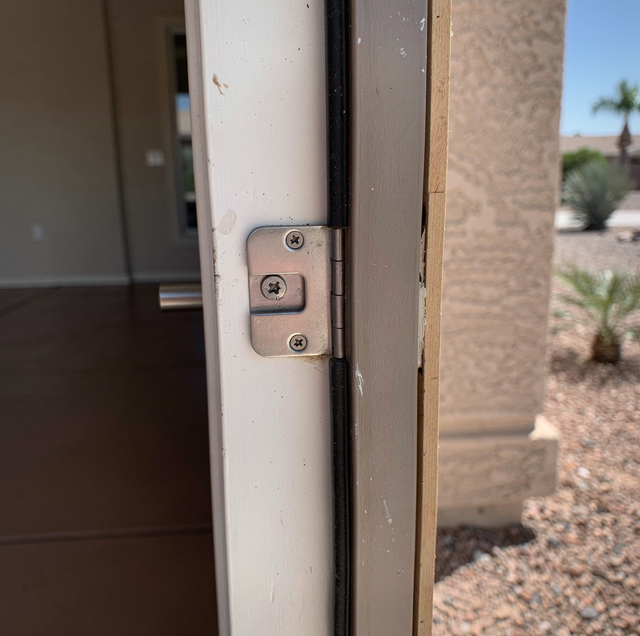
Quick Answer: A door that will not latch has moved, the strike has moved, or the lock has failed. Throw the bolt with the door standing open: if it runs smoothly, the fault is alignment, not hardware.
You pull the door shut, and it stops a hair short. A shoulder against the stile, a second push, and the latch finally clicks. Some mornings it catches on the first try. Some evenings you push twice and turn the deadbolt hard enough to feel it in your wrist.
None of that is random. A latch bolt travels a fixed distance from the door edge and must land within a hole of fixed size. When it stops doing that, one of three parts has moved, and the repair for each is different enough that guessing costs you a jamb.
Three Parts Have to Line Up, and Only One of Them Is the Lock
Open the door and look at the latch bolt. On a standard residential lockset, it projects roughly half an inch, its face beveled so the curve rides up the strike lip and pushes the bolt back into its case as the door closes. Once it clears the lip, the spring drives it into the opening in the strike plate and on into a pocket cut in the jamb behind. That opening is barely larger than the bolt, and the tolerance is the problem: a sixteenth of an inch separates a door that closes with a fingertip from one you lean on.
Three parts can produce that shift. The door can move: the slab has sagged, swelled, or swung on failing hinges. The strike can move: the plate or the jamb holding it has shifted, or was never set right. Or the lock can fail: the latch mechanism no longer throws its bolt the full distance. Each leaves a signature, and the four tests below run in the order that clears the most suspects soonest: rule the lock out first, because every alignment test after it assumes a bolt that can travel. A bolt that grabs inside its own housing during a hot stretch is a different fault from one that throws freely and lands in the wrong place.
Do not leave it overnight. A door that will not latch is a closed door, not a locked one, and it swings open under wind load or a firm pull. If the deadbolt still seats, throw it and treat the latch as out of service. If nothing engages, block the door from the inside with a floor-mounted stop or a security bar and use another entry until the hardware holds.
Throw the Bolt With the Door Standing Open
Stand the door wide open, clear of the frame, and work the lock. Turn the key from outside, the thumbturn from inside, and the handle. Watch the bolt travel.
With no strike to fight, the latch does only what its own spring and cam ask of it. A bolt that runs out smartly and retracts under finger pressure is a healthy lock, and every remaining suspect is geometric. A bolt that extends partway, travels rough, or creeps out and stays out has a fault inside the case: grit in the mechanism, a spring that has lost its temper, a worn tailpiece.
Every alignment fix below is wasted effort on a lock that cannot throw its own bolt. If the key itself is hard to turn or has snapped off, the fault sits inside the cylinder rather than at the strike.
Mark the Latch Bolt and Read Where It Lands
Coat the bolt and let the door tell you where it goes. Lipstick, a grease pencil, or a broad marker all work; what matters is a soft medium that transfers on contact. Cover the curved face and the flat back, close the door at normal speed, then open it and read the strike plate.
| Where the mark transfers | What has moved |
|---|---|
| Below the opening | The latch edge has dropped, usually hinge sag |
| Above the opening | The jamb has settled, or the door hangs high |
| Beside it, level | The door is not closing far enough in |
| Across the plate | Misalignment past a sixteenth |
| Clean, inside | Alignment is fine; look at the lock |
Distance matters as much as direction. A mark touching the rim is off by a hair, and a few strokes of a file will hold it. A mark a full bolt-width away is a door problem that filing cannot reach.
Read the Gap Down the Hinge Side and the Strike Side
Close the door and look at the reveal, the gap between slab and jamb, on both vertical edges. A door hung square in a square opening shows the same gap top to bottom on both sides.
A reveal that tapers is the mark of a slab that has rotated in its opening. Wide at the top of the strike side and tight at the bottom means the latch edge has swung down. Tight at the top of the hinge side means the hinge screws are pulling free. Either pattern says the door is the moving part and the strike is blameless.
An even reveal, with the bolt still missing, says the opposite: the slab sits where it always sat, and the target moved. That is usually a plate whose screws have loosened enough to let it creep, or a jamb nailed out of position when the frame went in.
Measure the reveal at three points down each side: top, middle, bottom. A door hung square reads within a sixteenth of an inch across all three. A taper of an eighth or more means the slab has swung, not the strike.
Loose Hinge Screws Let the Door Sag Toward the Strike
The top hinge carries most of a slab's shear load across three or four screws, typically three-quarters of an inch long. That puts their threads entirely inside the jamb board, with thin stock nailed to the rough framing, a shim space behind it. Wood fibers under repeated load crush rather than hold; the screw head sinks below flush, the leaf tips forward, and the latch edge drops.
Test it with a screwdriver, not your eye. Seat every screw in every leaf. A screw that turns without drawing tight has stripped its hole, and driving it harder will not bring it back.
Season belongs in this reading, in both directions. Wood slabs and wood jambs take on moisture in humid stretches and give it back in dry ones, each on its own schedule. A door that latches in one part of the year and refuses in another is reporting movement, not failure. A strike, relocated to suit the worst weeks, will miss the best ones.
Fixes That Move the Door Back Into Line
Work in order of reversibility: tighten, then lengthen, then shim.
Tightening takes a screwdriver and five minutes, and it settles more doors than anything else here. Seat every hinge screw on both the jamb and door sides, then re-close the door before going further.
Lengthening comes next. Swap one screw per hinge, the one nearest the door stop, for a three-inch screw that crosses the shim space and bites the framing behind the jamb. On a sagging door, that single change often lifts the latch edge back into the strike opening. It also pulls the jamb a hair toward the framing, so re-run the marker test before touching anything else.
Shimming is the fine adjustment: a thin shim behind a hinge leaf pushes the door away from the hinge jamb at that height, and shimming behind only the top or bottom screws tilts the leaf and swings the far corner. Deepening a mortise does the reverse and is harder to undo, so it comes last.
Fixes That Move the Strike, and the Screws That Hold It
A strike plate is stamped steel, thin enough to file, and filing is the first thing most people reach for. Inside a narrow band, it is a real repair: opening the hole a sixteenth of an inch toward where the bolt is landing will capture a bolt that is just missing.
Past that, filing stops working. The opening loses its square edge, and the bolt rattles inside it; the lip thins where it takes the impact of every closing, and the pocket cut into the jamb behind has not moved, so a widened opening only guides the bolt into solid wood a quarter inch in.
The honest repair past a sixteenth is to move the plate. Take it off, plug the old screw holes with glued dowel so fresh screws have something to bite, mark the new position from the marker test, cut the pocket to match, and reset the plate dead flush.
Then there is the part that matters more than latching. A kicked door rarely fails at the cylinder or through the slab; the jamb splits along the grain where two short screws hold the strike plate, because those screws end inside a three-quarter-inch board with a hollow shim space behind it. Replace them with three-inch screws that reach the framing and the whole wall becomes the thing being kicked. A reinforced box strike with four long screws buys more real security than any cylinder upgrade.
When the Lock, the Frame or the Door Is the Real Problem
If the door-open test showed a latch that binds, alignment work is beside the point. On most cylindrical locksets, the latch is a separate cartridge held in the door edge by two screws, replaceable without disturbing the cylinder or the handles. The usual failure is a rounded bevel: after tens of thousands of closings, the curved face wears flat enough that it no longer rides the strike lip. Reading a lock for wear before it quits is a separate inspection, and it will not help a door that is out of square.
Some doors are past hardware. A slab that swelled and never came back, a bottom rail that soaked and grew, or a jamb out of plumb will defeat the strike no matter where the plate goes. Repetition is the tell: if you have chased the bolt with the plate more than once, the frame is what is moving. A swollen slab can sometimes be planed back at the binding edge, but bare wood left unsealed takes the moisture straight back on.
A door that stopped latching within days, along with a jamb that has visibly shifted, suggests something structural rather than hardware.
Never cut a new strike mortise in a fire-rated door frame. A rated assembly's listing covers the openings it left the factory with; changing them is the manufacturer's and the listing lab's call, not a field decision.
Frequently Asked Questions
It can. A fresh compression seal stands taller than the flattened one it replaced, and the door needs the extra push before the latch reaches the strike. Give a new seal a few weeks of compression set before moving a strike plate to suit it.
Just the latch, in most cases. It is a self-contained cartridge that swaps out in minutes, but it has to suit the backset, the distance from the door edge to the center of the bore. Residential doors use two standard backsets, two and three-eighths inches and two and three-quarters. Most replacement latches now ship adjustable between the two; a fixed one has to match what is already cut.
A deadbolt has no bevel, so it cannot push its own way in. It needs the strike opening lined up before it moves at all, and a pocket in the jamb deeper than its throw, which on a Grade 1 deadbolt is a full inch. A latch that catches while the deadbolt refuses usually means that pocket was cut shallow or has packed with debris.
More than filing does. Filing the existing opening runs out at about a sixteenth of an inch; a purpose-made adjustable strike buys roughly an eighth, which is what it exists for. The cost is play: an opening larger than the bolt lets the closed door shift inside the frame, which shows up as rattle in wind. Use it where the misalignment is small and stable, not to paper over a slab that is still sagging.
It can, and there is a quick check. Structural movement rarely shows at one door alone. Look for a second door in the same wall binding, a diagonal crack out of a door or window corner, or a window in the same run gone stiff. One door out of line is hardware. Three symptoms in one wall are a call to a structural trade.
Paint has thickness. Each coat adds a few thousandths of an inch to both the slab edge and the jamb, so two or three coats on a door that was already tight can keep the bolt from seating. Paint bridging the strike opening narrows it as well. A sharp blade run around the opening, and a light sanding of the latch edge clears most of these without turning a screw.
Have a locksmith read the door before anything gets drilled — get the slab, the strike, and the latch tested in one visit so the right part gets fixed the first time. KwikPick Lock and Safe serves the Phoenix West Valley. Call (623) 300-1889.
