
Forgot Your Safe Combination? The Routes That Still Work
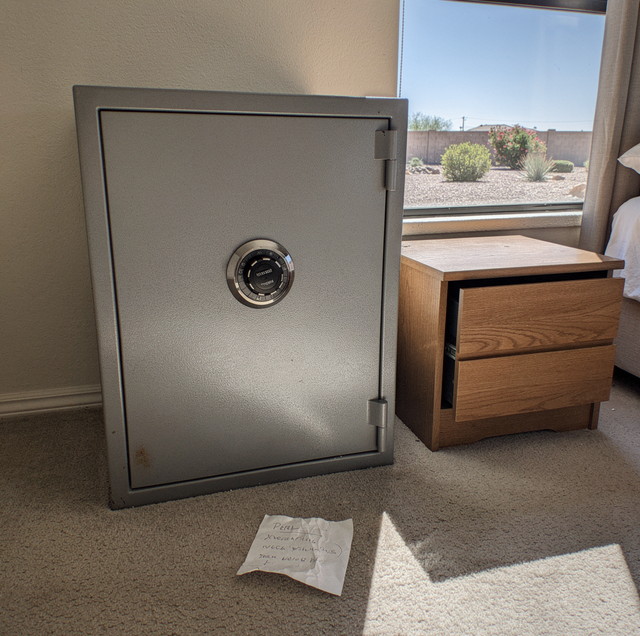
The passport you need is in the safe, the flight is in four hours, and the combination that has opened that door every few months for six years does not open it now. Three attempts, then a fourth, slower, with the scrap of paper you kept in your desk drawer flattened out in one hand. The handle still will not turn. Nothing is broken, and nothing has failed: a safe that refuses a number it does not recognize is doing precisely the job you bought it to do, which is the part that makes it feel so unreasonable. The word you reach for is forgot, and it covers four separate situations with four separate ways out. Which one you are in changes everything that follows.
Forgotten Rarely Means Gone: The Places a Combination Still Lives
Forgot covers more ground than the word suggests. There is the safe that came with the house or through an estate, where nobody living knew the number. There is the number written on paper that is now gone. The combination changed a year ago, while the old one keeps coming back to the fingers. And there is the number that is entirely correct and refused anyway, a different problem wearing the same clothes. Naming which one you are in saves the afternoon.
Before any route below, the number is worth hunting: it survives in more places than people expect. Safes bought new ship with a factory-set combination printed on a card in the manual, and that packet usually ends up in a file box. The selling dealer keeps the sale on record against the serial number. There may be a photograph of that card on an old phone, an entry in your password manager filed under something other than safe, or a copy in the paperwork a parent kept.
An inherited safe or an auction buy is a different starting position. Nobody in your house set that combination, so there is nothing to remember and nothing in a drawer. The safe still carries its serial number, the thread every remaining route hangs on. Everything below depends on getting it off the body and written down before you call.
The Manufacturer May Still Hold the Original Factory Code Record
Most residential safe makers set a combination at the factory and record it against that unit's serial number. American Security, whose safes carry the AMSEC name, is one line where such a record can be retrieved. The request normally travels through an authorized dealer or a locksmith account instead of going direct to you, and it moves at the speed of correspondence: days, never the same afternoon.
There is a real limit on this route, worth knowing before you pin hope on it. The factory record holds the combination the safe left the factory with. If it was changed afterward, and most owners change it in the first week, the factory number will not move the bolts. On a safe set once at delivery and never touched, it remains the cleanest route available to you.
The Override the Manufacturer Built In, and Its Usual Catch
Almost every electronic safe lock ships with a keyed mechanical override and two keys cut for it, so a flat battery or a failed pad never leaves you with a safe you cannot open. A dark keypad on a safe deserves one sentence here: it is usually a power issue, and on most models, the battery compartment is accessible with the door shut.
The catch is the key itself. An override key nobody can find is no route at all, and replacing one is never a job for the local hardware counter. Safe override keys are ordered by code from the manufacturer against the serial number, and a restricted profile cannot be duplicated by anyone outside that network. Ordering a replacement takes the same number of days as the factory record, which puts both of your routes on one clock.
Worth establishing before an emergency: most safes have more than one designed entry point, and the number varies. A keypad model usually has the pad and the override. A mechanical dial usually has only the dial. A fingerprint model normally carries three inputs. Working out which route your own safe was built with, while it stands open, converts a locked safe into a short list.
What Happens After You Hand the Problem to a Locksmith?
What you are arranging at this point is an outcome in two parts. The safe is opened, and then the lock that could not be operated is repaired or replaced, so the safe goes back into service with a combination you set yourself. An opening that ends with a working safe and a working lock is the whole deliverable; one that leaves the safe unusable afterward is half a job.
Expect a short set of questions first: the make, the model, and the serial number, whether the lock is mechanical or electronic, and whether the safe is anchored, since an anchored safe is worked where it stands. Expect to be present throughout. And expect a plain account of what the safe will be like afterward, because a technician who will not describe the after has not answered the question.
Mechanical and Electronic Locks Send You Down Two Different Routes
The reason the routes diverge is that the two lock families keep the combination in completely different places. A mechanical dial lock holds its combination physically inside the lock body, in a form that nothing outside the lock can interrogate, so the only copies in existence are the factory record tied to that serial number and whatever the owner wrote down on paper. An electronic lock keeps its code in memory, and memory has properties a mechanical state does not: it can be rewritten in seconds once the door is standing open, it can be lost when power is lost, and it arrives paired with a second designed-in way in, the keyed override. Same problem, two different inventories.
The practical consequence lands early. A dial safe with no written record and no factory record has one route left in front of it. An electronic safe usually has two before that point.
Which family you own is the first thing to establish, and it takes ten seconds at the door of your own safe. A numbered dial with an index mark is one family. A pad with digits is the other. A fingerprint reader sitting over a pad is still the second family with an extra input added, and your route list there is the electronic one.
Getting the Safe Back in Service Once It Is Open
Once the door is open, the work is not finished, and testing is the part that gets skipped. A new combination gets set, and the pull is to shut the door and get on with the day. A new combination is tested several times with your door standing wide open, before anything closes. Most residential safe locks use a common mounting pattern, so the replacement is a choice rather than a fixed spec: an owner stranded by a flat pad often switches to a mechanical dial.
The distinction this whole problem turns on is that it is a recovery route, not a rescue. Nothing inside is at risk, and nothing has broken. The one missing piece is a number, and it's the only part of your safe that can be replaced without touching the steel.
Frequently Asked Questions
An electronic safe lock imposes a timed penalty lockout after a run of incorrect entries, and the exact attempt count and the wait time are printed in your lock's instruction sheet. The pad stops accepting input until it clears, and retrying inside that window restarts your clock, so wait it out and give yourself one careful try.
No. A replacement lock arrives with its own factory setting and no memory of what came before, so the number you used for years does not carry across, and anyone who once knew your old number still knows it. A new lock accepts codes of one fixed length only, so a number of the wrong length is ruled out before you choose.
A wrong entry is refused by the lock; bound bolts, by the door. If the lock runs its motor or reaches its opening position but the handle will not move, the number was accepted, and the bolts are loaded, usually because the door has dropped on its hinges or something inside leans on it. Easing the door inward while turning the handle is the ordinary answer; you feel it in your hand.
When the sensor stops working, the enrolled prints are usually still in memory, and the power has failed, so your code is the route to try before you go hunting for your override key. Enrollments live inside the lock body, so a lock replaced later takes every stored print with it and every finger has to be enrolled again from the start.
Often it is not. The serial identifies the body and the model that left the factory, and many makers fit more than one lock brand across a production run, so the second question is which lock sits on your door. A clear photograph of the front of your safe, taken before you call, will usually cover it.
Because it has no daily job. Every other key earns its place by being carried, and an override key, touched once every few years, drifts into a junk drawer, a toolbox, or the safe it opens. Your two keys are cut to the same code, so keeping them together makes them one; the spare exists to keep your safe off a wait you cannot shorten.
Getting a safe open without harming the safe is routine work for a mobile locksmith carrying safe tooling — the make, model, and serial number start it, and the visit is scheduled for a time when you can be there. KwikPick Lock and Safe serves the Phoenix West Valley. Call (623) 300-1889.
