
Car Stopped Detecting Your Key Fob? What Broke in Between
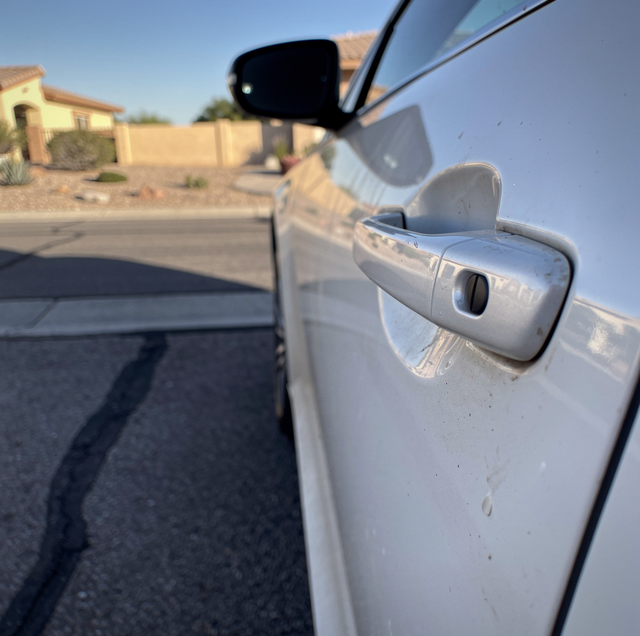
Your hand is on the driver's door handle, the fob is in your pocket where it always rides, and the door stays shut. You try again, slower, with a fuller grip. Nothing. So you pull the fob out and press the button, and the doors open on the first press.
That sequence has already ruled out a lot. The fob has power, a transmitter, and a code your car accepts, because the button proved all three at once. What stopped is the other exchange, the silent one your car runs the moment you touch a handle. Passive entry is a conversation with two halves on two radio bands, and either half can go quiet alone.
The Car Speaks First and the Fob Answers
Touching the handle activates a sensor, which tells your car to ask a question. That question leaves a low-frequency antenna built into the handle, at around 125 kHz. Close to the antenna, what comes off the coil behaves as a magnetic field rather than a radio wave, and it fades fast with distance. Your car has to place the fob within arm's reach of one specific door, and only a field that dies off that fast stays confined to one handle.
The fob sleeps until the field reaches it. A coil inside wakes the chip, which computes an answer from a value paired to your car and sends it back on an entirely different band. In North America, the reply goes out near 315 MHz, at the low power federal rules allow for periodic unlicensed transmitters. That leg carries much farther and arrives much weaker.
The two halves are lopsided, and they fail for different reasons.
Where the Antennas Sit and Why One Door Fails
A single antenna cannot tell your car whether you are outside the driver's door or sitting in the seat, and that distinction is the basis of passive entry. So the system runs on several low-frequency antennas with small, overlapping zones: one at each front handle, at least one in the cabin, one at the rear on cars with a hands-free trunk. Your car reads your position from which antennas answered.
That architecture is why detection can be flawless at one door and absent at the next. Each front handle carries its own antenna and its own sensor, on its own branch of the wiring. If the passenger door responds and the driver's door ignores you, nothing about the fob changed between attempts. Either your car never asked there, because the sensor is not registering your hand, or it asked and that handle's antenna put out nothing the fob could hear.
Dust and fine grit pack into the gap behind a handle, and a sensor reading the change in capacitance as your fingers arrive is sensitive to what sits on top of it. That fault has a signature you can feel: the door answers a slow, full-hand grip and ignores a quick pull.
What Raises the Noise Floor Around Your Car
A radio receiver has no absolute sensitivity. Its threshold sits relative to the noise already in its band, so anything lifting that noise floor raises the bar the fob's reply has to clear, and the fob transmits at a power held down by unlicensed-device limits.
If detection fails in the same parking structure every evening and never on your driveway, the fob is not the variable.
A structure like that works against the band twice. Steel and concrete reflect and absorb the reply, so the receiving antenna collects several weak copies arriving slightly out of step, and these out-of-step copies subtract as readily as they add. Then there is the equipment sharing the space: the switching supplies inside LED fixtures and the power electronics in vehicle charging equipment both put energy into the band the fob answers on.
You can test it without buying anything. Park your car on open ground for a day and try the handle there. Detection that returns outside has located itself in the building.
A Fob Against a Phone, a Laptop or Another Fob
An object touching your fob interferes at whichever step of the exchange it reaches, so walk the exchange from first step to last.
The first step is your car's low-frequency question arriving at the fob's coil. A wireless charging pad is an everyday device operating in the same region: the wireless charging standard used by phone charging pads puts power transfer between 87 and 205 kHz, straddling the 125 kHz your car asks for. A fob on an active pad in the console sits inside a field far stronger than the one from the door.
The second step is the fob's reply. Pressed flat against the metal back of a phone or the lid of a laptop, the fob has a conductor in its near field, which changes what its antenna is coupled to and how much power leaves as radiation rather than heating the metal.
The third step is your car's receiver. Two fobs on the same ring both wake, both compute, and both answer on the same channel within milliseconds of each other, leaving the receiver with two overlapping replies and no clean one.
The check that falls out of all three is one motion: hold the fob by itself, away from your body, and try the handle again.
Is the Fob Silent, or Is the Car?
One test in your driveway separates a silent fob from a silent car. Press a button on the fob. If the doors respond, the fob transmits, and the rolling code still matches, so the fault has narrowed to the passive side: the question, the handle sensor, or the path the reply takes back. It does not clear the cell because waking and answering require more of it than a single button press. If the buttons do nothing either, the fob itself is in question, and fob power and heat damage are a separate diagnosis.
Borrow the second fob next. Two fobs failing the same way at the same door points at your car. One failing where the other works points at the fob.
There is a third move, and your owner's manual carries a page for it. Push-button cars keep a fallback position for the fob, a slot in the console or a marked spot on the column, and holding it there while you press the brake and the start button runs the engine with no passive detection at all.
What a locksmith brings is the reading you cannot take yourself. A low-frequency probe held against the handle shows whether your car emits its question when you touch it, and how strongly. That separates a fob fault from a car fault before any part is bought. Drop a new fob into a car that never asks, and it fails just like the old one.
Frequently Asked Questions
Closer than you would guess, and the drop-off is steeper than distance suggests. At 125 kHz, the question travels as a near-field magnetic field, and near-field strength falls with the cube of distance, so standing twice as far from the handle leaves the fob roughly an eighth of the field. That steep edge is what lets your car separate outside from inside. It also explains why the zone ends so abruptly at its boundary.
Your car does not ask once and give up. Touching the handle opens a short window in which the module repeats its question on a cycle, and each exchange finishes in a fraction of a second, so a fob at the edge of the zone can miss the first repeat and answer the third. A door that responds only on a second grab has little margin left.
Yes. Starting asks the interior antennas to place the fob inside the cabin, and that interior zone is smaller than the cabin itself. A fob you pushed deep into a door pocket against the sill, or left under a seat with a metal frame over it, can fall outside the zone even while sitting in the car. The dash then shows no key found.
Both do, at opposite severities. A pouch lined with conductive fabric is a deliberate enclosure, and a fob left in one is the tidiest explanation for a car detecting nothing anywhere. A heavy ring of keys pressed flat against the fob body sits inside the coil's near field and draws energy out of it, shortening the range at which the fob hears your car.
It can, and one spot produces the pattern where a single door fails. The wiring for that door's antenna and sensor crosses from the body into the door through a rubber boot at the hinge, and those conductors flex every time you swing the door. A conductor cracked inside its insulation; there can pass a continuity check with the door shut and open the circuit as it moves.
Slide the mechanical blade out of the fob body; fobs that carry one have a release catch on the case, and the driver's door keeps a keyhole behind a cap on the handle. Starting uses a separate system: the immobilizer chip in your fob has no battery and no transmitter, so a coil at the fallback position energizes it and reads the reply back through that same field, over inches rather than across a parking space.
A car that no longer detects the fob at the handle — the challenge at each door and the fob's reply both get read before any part is replaced. KwikPick Lock and Safe serves the Phoenix West Valley. Call (623) 300-1889.
