
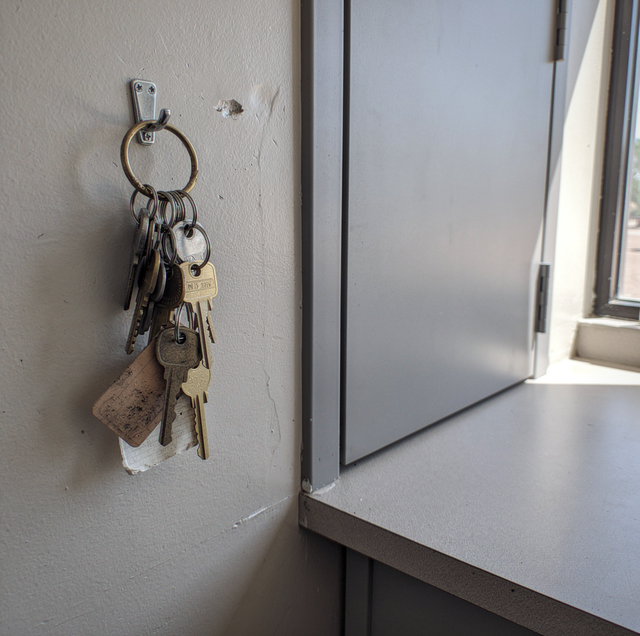
A business's keys start as a short, memorable list: one for the front door, one for the back, maybe one for a storage room. Then a new hire needs a copy. A vendor gets one to let themselves in on weekends. A supply closet gets locked after inventory started disappearing. None of those additions feels like a turning point on its own. But somewhere in that slow accumulation, the person managing the business can no longer say, with any confidence, exactly who holds the key to exactly what. That moment, not a specific door count or headcount, is what signals it's time to think about a master key system instead of a pile of individually cut keys.
What a Master Key System Changes
Setting one up means pinning ordinary cylinders rather than buying a special line of hardware. Each door keeps its own key, called a change key, that opens only that door, and each cylinder also accepts a master key cut to a pattern shared across the whole system. Layered on top of that, a single master key is cut to a pattern that aligns with every cylinder across the whole system, so the person holding it can walk through any door without carrying a separate key for each one.
The two keys work because a locksmith builds a second valid combination into each cylinder, in addition to the door's own combination. The change key still has to match its door exactly. The master key matches a different, shared pattern that every cylinder in the system is also set to accept. A master key holder can open a specific office, but an employee holding only that office's change key cannot open anyone else's door. That asymmetry, one specific key per door and one shared key across the group, is the entire point of the system.
How Many Doors and People You're Managing
The signal has nothing to do with a specific number and everything to do with whether you can still describe your key situation from memory. A shop whose owner can still name every key holder from memory can run on individually cut keys; once the honest answer to "who can get into which room" becomes a guess, the case for a master system begins. Add a second location, a third interior room that got locked after a theft, or enough turnover that the same door has been rekeyed under different sets of keys more than once, and the picture stops being something you can hold in your head.
A master system compresses that sprawl instead of eliminating it. It doesn't reduce the number of doors or the number of people who need access to some of them. What it changes is how many keys a person with broad responsibility has to carry to reach it all: one master key instead of a ring holding a separate cut for every room they're cleared to enter. For an owner or manager who moves between the front counter, the back office, and a storage area during the same shift, that's the difference between one key and four.
Who Needs Which Doors
Not every person who needs to get into the building needs to get into every room in it. A business with a front counter, a cash drawer, an equipment room, and an owner's office has at least four different answers to who should be able to walk in there, and a single shared key answers all four questions the same way: yes, to everyone who has that key, whether or not that matches what the business intends. It's just the default you end up with when doors get keyed one at a time as they're added, with no plan for who is supposed to reach what.
A master key hierarchy lets each answer be different without handing out a separate, unrelated key for every room combination someone needs. A staff member working the counter can hold a counter submaster that opens the counter area and a shared entrance. Someone responsible for inventory can hold a submaster that adds the equipment room to that same short list. A key that reaches everything stays with the small number of people whose role calls for it. The signal to watch for is a gap between who currently can get into a room and who should, based on their job rather than their seniority or how long they've worked there.
Turnover and Lost Keys
A business that rarely changes staff and rarely misplaces a key can run on individually cut keys, because the number of copies in circulation stays small and easy to track. Turnover changes that math, and so does an occasional lost key: seasonal hiring, contractor turnover, hourly staff who cycle through on a regular basis, or a key that goes missing now and then all add up to the same result, more keys issued and collected than any one person can hold in their head.
The threshold to watch is how frequently keys are being reissued, not how many are out at any one moment. A business that only occasionally adds or removes a key holder can track that by memory or a simple log. Once change happens frequently enough that the log itself is hard to keep current, a tiered system, one shared master for the few people who need full access and individual keys for everyone else, is simpler to maintain than a flat set of identical keys handed out and returned on a rolling basis.
Restricted Keyways and Key Control
A master key system's tiering only means something if the keys themselves can't be freely duplicated. Most residential and light-commercial keys are cut from blanks any hardware store or kiosk stocks, which means anyone holding a key for even a few minutes- an employee, a cleaning contractor, a delivery driver- can walk it into a store and walk out with a copy nobody authorized or logged. For a business relying on tiered access to control who reaches what, that's a hole in the plan: the tiering only holds if the keys stay where they're supposed to.
A restricted or patented keyway, whose blanks are sold only through authorized locksmiths instead of off a hardware-store rack, closes that hole by controlling the blanks themselves rather than just the lock. Blanks for a restricted keyway aren't sold over the counter; cutting one requires signed authorization tied to a specific person or business, usually verified directly by the locksmith or manufacturer. Pairing a master key hierarchy with a restricted keyway means the tiering set up on paper, who holds a change key versus who holds the master, reflects who's able to get a working key cut, not just who has one today.
What a Master Key System Does Not Do
A master key system solves a specific problem: allowing more than one tier of keys to open the right combination of doors. It's worth being just as clear about what it doesn't solve, because a business can adopt one expecting capabilities that only an electronic access system provides.
A mechanical master key system keeps no record of who used a key or when. If a door was opened at two in the morning, nothing about the key or the lock tells you who turned it, only that it was turned by a key cut to fit. It also can't be limited by time or schedule. A key that opens a door at nine in the morning opens the identical door at nine at night, on a Sunday, or on a day someone was supposed to be off. There's no way to grant someone temporary access that expires on its own; the only way to end a key's usefulness is to rekey the lock it opens.
Keep a written log of who holds each tier of key, updated the moment a key changes hands. A mechanical master key has no built-in record of use, so that log is the only place that information exists.
None of that makes a master key system the wrong choice. For a business whose real problem is an unmanageable pile of individually cut keys and unclear role-based access, a mechanical hierarchy solves exactly that, with hardware a locksmith can set up. But if the actual need is a record of who entered and when, or restricting access to certain hours, that's a different kind of system, built around credentials and logs rather than pins and cuts, and it's worth naming that difference before assuming a master key system will cover it.
Frequently Asked Questions
Master pinning splits one or more of a cylinder's pin stacks into two pieces instead of one, giving the cylinder a second valid break point for the master key alongside the original one for the change key. Splitting more stacks makes room for more distinct change keys under the one master, but it also gives a pick more separate points to work, which is why high-security rooms are sometimes left off the master entirely.
No, though the terms get used interchangeably. Keying alike means several locks share a single combination, so a single key works in each of them without a second key. A master key system keeps each lock's individual combination different, so losing a single change key only exposes the one door it opens; only losing the master itself reaches further.
More than one door is exposed at once, which is why a master is worth treating differently from an ordinary change key well before it ever goes missing: have it stamped with a control number instead of a door or room name, and keep it off a vehicle key ring or anywhere it could get left behind during a service call. A change key left behind is a one-door problem; a master treated the same way is not.
Often yes, if every cylinder involved uses a keyway a locksmith can re-pin, since master keying is a pinning change rather than new hardware in most cases. The catch is a business that's grown by installing whatever locks were on hand over the years may have several incompatible keyways in one building, and those have to be swapped for compatible cylinders before they can share a single master, which is the one scenario where adding a master system does mean replacing hardware.
Not in the mechanical sense. An electronic lock has no pins to split, so the equivalent is a credential hierarchy: a manager's code or fob is programmed with permissions a regular employee's code doesn't have, rather than a second physical key working alongside the first. A building that mixes physical and electronic locks runs both systems side by side: a mechanical master for the traditional cylinders and a permissions tier inside the electronic locks' own software.
The standard hierarchy runs: change key, submaster, master, and grand master, with a great-grand master above that when a single owner holds several buildings. Each additional level consumes part of the cylinder's available pin combinations, so a locksmith plans the top of the hierarchy before the first cylinder is pinned, even if the upper levels remain empty for now.
Map out a master key system for your business — get a locksmith to structure who opens what before the key ring outgrows your records. KwikPick Lock and Safe serves the Phoenix West Valley. Call (623) 300-1889.