
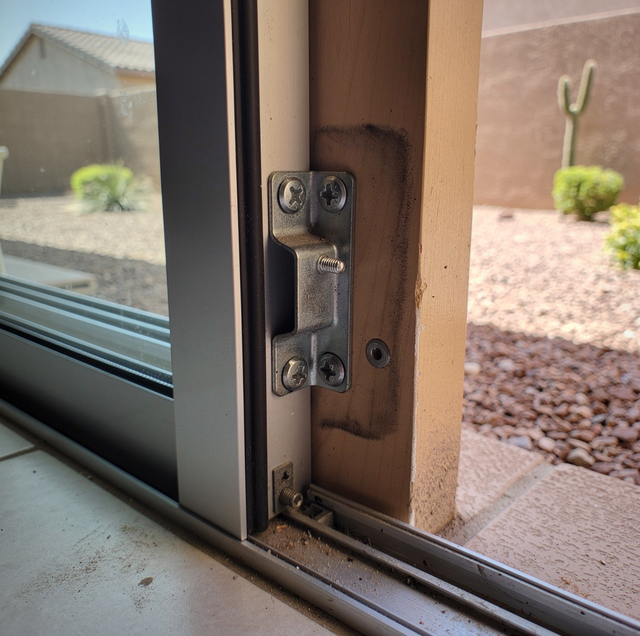
A sliding glass door locks nothing like a hinged one. Instead of a bolt traveling into a fixed strike cut in a doorframe, a hook or claw hidden in the door's edge swings out when the lever turns and catches on a keeper screwed to the jamb. That hook meets that keeper at one specific spot: the exact height and position where the door comes to rest at the end of its slide. Move the door even slightly off that spot, on its rollers or in its track, and the hook swings through open air instead of catching steel.
When a sliding door won't lock, or locks but still rattles and can be pried back, the fault sits in the latch mechanism, the keeper it's supposed to catch, or the door's own position on its rollers and track. Each looks different from inside the room. What the door does when the lever turns narrows the fault to one of those parts, and each part has its own fix:
| What You See | What's Involved | What the Fix Involves |
|---|---|---|
| The lever moves, but nothing catches | A disconnected or broken latch mechanism | The latch reconnected or replaced |
| The hook catches only when the door is lifted or pushed | Roller height out of adjustment | Rollers reset to their working height |
| The door locks but rattles and can be pried back | The keeper has shifted, or its screws are loose | The keeper reset and refastened |
| The lever is stiff or won't stay in the locked position | A worn or damaged latch | The latch mechanism replaced as a unit |
| The door drags or rides unevenly before reaching the jamb | A blocked or damaged track, or worn rollers | Track cleared or straightened, rollers replaced |
| The keeper screws are loose, or the keeper has moved | Stripped screw holes or a keeper that has crept out of place | The keeper reset with fresh anchor points |
How the Hook and Keeper Lock a Sliding Door
Turn the lever on a sliding door, and a cam inside the lock housing rotates, pulling a hook or claw out through a slot cut in the door's edge. That hook swings into a keeper, a small formed piece of metal screwed to the jamb, and its curved lip catches the inside face of the keeper's opening so the door can't be pulled back along the track. Lower the lever, and the cam pulls the hook back flush with the door edge, clearing the keeper so the door slides freely again.
The whole system works only because the door stops at a single repeatable point at the end of its travel. A hinged door's latch has a bevel that lets it find the strike even from a slightly different swing; a sliding door's hook has no built-in forgiveness for that. The hook has to arrive at nearly the same height and depth every time the door closes, which is why a problem anywhere else along the door's path can first show up as a lock that won't catch.
A Door Riding Too Low or Too High
Every sliding door hangs from a set of rollers running on the bottom track, and the rollers may include an adjustment screw that slightly raises or lowers the door to set how it rides. Rollers wear down with use, the wheel surface flattening or the axle developing play, and as they wear, the door settles lower in its track than it did when it was installed or last adjusted. A door that has dropped even slightly can put the hook below the opening in the keeper, so the lever turns but the hook passes underneath rather than catching.
The opposite can happen too: a roller adjusted too high, or a door lifted slightly out of true on a bent track, sends the hook above the keeper, opening instead. Either direction produces the same symptom from inside the room: a hook that only catches when the door is lifted or pushed into a different position first, and neither is something to force. A sliding glass panel is heavy enough to strain or fall off its track if it's lifted or shoved to compensate, so the door's height is set by adjustment at the rollers, and leaning on the door every time it closes only adds strain.
A glass panel that comes off its track can strike or trap a person under real weight, so nobody pries or lifts one to force a stubborn latch. A locksmith adjusts roller height without pulling the panel free.
The Keeper on the Jamb
The keeper takes a direct hit every time the hook swings into it, and that repeated impact can loosen the screws holding it. Loose screws let the keeper shift slightly in whatever direction the door's closing force pushes it, and once it has moved even a small amount, the hook can miss the opening entirely or catch only at an angle, which is what lets a locked door still rattle and get pried open.
Wood behind the keeper screws can strip out: once the fibers around the threads crush down, the threads have nothing left to bite. A keeper reset into stripped holes with the same screws will not hold any better than it did before, so the fix is fresh anchor points for the screws. A keeper that has visibly shifted from its original mounting marks can also mean the jamb itself took an impact at some point, which is worth a look before the keeper goes back on.
The Track and Rollers
A door that drags, catches, or stops short of the jamb before the hook ever reaches the keeper can have nothing wrong with the lock at all. Dirt, grit, and small debris can settle into the bottom track and build up enough resistance to stop the door a fraction short of where it needs to be for the hook to line up, which reads exactly like a lock problem from inside the room.
A dented or bent section of track changes where the door stops the same way, since the rollers ride along whatever shape the track has rather than the shape it started with. A short dent from a dropped tool or a moved appliance can sometimes be corrected without replacing the whole track; a bend along a longer section of the track changes the roller's path enough that the door won't reach a consistent stopping point at all, and that calls for replacing the damaged section.
A track cleared with a stiff brush and a vacuum nozzle, with the door slid fully to one side and then the other so every length of track gets reached, settles whether debris was stopping the door short.
A Worn or Broken Latch
Not every failure to lock traces back to the door's position. A door with cracked or broken glass is never slid or forced to get a stuck latch to engage; that damage gets addressed before the lock does. Past that, the latch mechanism itself, the housing that turns lever movement into hook movement, wears and can break. A hook that no longer swings its full distance, whether from a worn pivot or a broken return spring, can't reach a keeper that's mounted correctly and adjusted correctly, so a door sitting at the right height still fails to lock.
A lever that feels loose, spins without resistance, or won't hold in the locked position can report a broken connection inside the housing rather than a keeper or roller problem, since a healthy latch resists turning the whole way through its travel. Once the latch itself is confirmed as the failing part, the mechanism is swapped as a single unit. A stiff lever is not forced with a tool, since a snapped hook can leave the door unable to lock at all.
Added Security Once the Lock Works
A door that won't lock overnight is safer closed and blocked with a temporary bar in the track than left resting on a latch that isn't catching; once the hook and keeper are catching reliably again, that same bar or a permanent pin set into the track adds a second point of resistance the latch alone doesn't provide.
Frequently Asked Questions
On a door with an outside key cylinder, the cylinder turns the same hook through its own cam or tailpiece, separate from the inside lever. A lever that still sets the hook while the key turns without moving it narrows the fault to the cylinder's connection to the lock, and that cylinder or linkage is repaired or replaced on its own.
Where the aluminum has only dented, the rail can be worked back into line with the door slid clear of that spot, which is repair work rather than a homeowner job. A rail with a crack or split along its lip is replaced because a roller riding over it can catch on the split.
Not on its own. Dry wheel bearings can grind or squeak while the door still rides at its set height, so noise alone is a maintenance sign rather than proof the rollers need replacing. A hook that's missing the keeper, or a door that drags, can mean the rollers have moved past noise into a height problem.
No. Some use a single hook that swings into one keeper, while others are multipoint locks that throw hooks at multiple heights along the door's edge, each catching its own keeper. On a multipoint lock, a door that locks but rattles can be holding at one keeper while another hook misses.
The screen runs in its own outer track and catches on its own latch, clear of the glass panel's hook and keeper. A screen frame that has bent or come off its rollers can rub the glass panel's handle as it closes, and that contact is corrected at the screen.
It can. Hook shape, hook throw, and mounting-hole spacing differ among sliding door lock designs, so a replacement latch of a different design may come with its own keeper. The keeper matched to the new hook then goes on the jamb in place of the old one.
Hire sliding door lock repair — latch, keeper, and roller height adjusted, or a worn latch replaced. KwikPick Lock and Safe serves the Phoenix West Valley. Call (623) 300-1889.