
Mortise vs. Cylindrical Lock: Which One Guards Your Door?
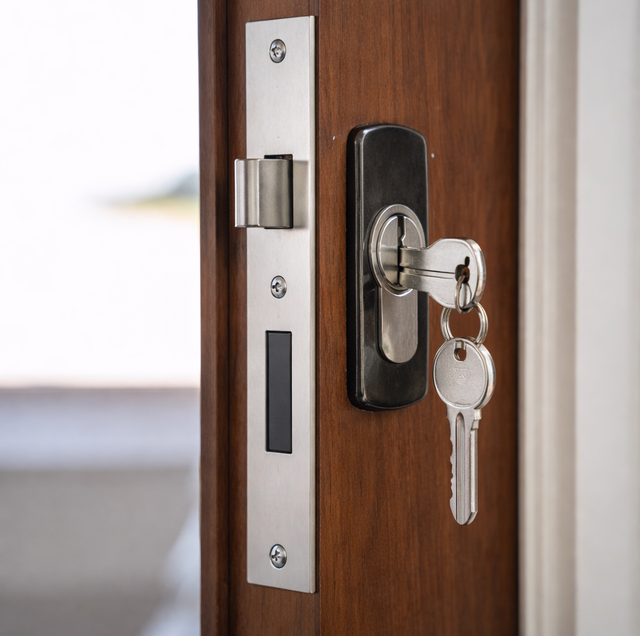
Quick Answer: A cylindrical lock installs into round holes bored through the door face and edge, which makes it affordable and quick to swap, so it dominates homes. A mortise lock sits inside a rectangular pocket cut into the door edge, holding one heavy lock body that combines latch and deadbolt, so it runs stronger and shows up on commercial, apartment, and high-end entry doors.
If you have ever pulled a lock off a door and wondered why one type dropped out in three pieces while another lifted out as a single steel block, you have run into the two families that cover almost every entry door: cylindrical and mortise. They latch a door and take a key, but they are built and installed in completely different ways, and that difference shapes cost, strength, and where each one belongs.
How Each Lock Is Built And Installed
The clearest way to tell these two apart is to look at the hole the door needs, not the trim you see from the hallway.
The cylindrical (bored) lock: A cylindrical lock, also called a bored or tubular lock, drops into two intersecting round holes. A large hole, usually 2 1/8 inches across, is bored straight through the face of the door for the lock chassis and the knob or lever. A smaller hole, typically 1 inch, is drilled into the edge of the door to meet it, and the latch assembly slides in there. The two knobs or levers thread onto the chassis from either side and pinch the door between them. Most of the mechanism lives inside those knobs and the small chassis, so the parts are compact and comparatively light.
The mortise lock: A mortise lock needs a rectangular pocket, the mortise, chiseled or routed into the edge of the door. Into that pocket slides a single rectangular lock body, a steel or brass case that can be several inches tall and an inch or more deep. That one case holds the latch, often a deadbolt, the cam that the key turns, and the springs that drive everything. Trim and cylinders attach to it through the face of the door, and a long faceplate screws to the door edge. Cutting a clean mortise pocket is skilled work, which is a large part of why this lock is treated as the premium option.
So before any talk of strong versus weak, the split is physical: round holes and a small chassis on one side, a milled pocket and one large lock body on the other.
Cylindrical Locks: Strengths And Trade-offs
Because the bored design became the North American residential standard decades ago, its advantages are the ones most homeowners already rely on without naming them.
Where it wins: Cost is the headline. A cylindrical lockset uses less metal and simpler machining, so it sits at the affordable end. Installation and replacement are fast: the door prep is standardized, replacement locksets are sold in every hardware aisle, and a worn knobset can come off and a new one go on in minutes with a screwdriver. Parts and finishes are easy to source, and a locksmith can rekey most residential cylindrical locks quickly.
Where it gives ground: The same compactness that makes it cheap makes it lighter duty. Force lands on a small chassis and the two through-bolts holding the knobs, rather than on one large steel case, so a builder-grade bored lock has less material standing between a kicked door and the frame. More of the working mechanism is exposed inside the knob or lever, so hard daily use and abuse wear it faster. This is why a plain knob lock on an exterior door is usually paired with a separate deadbolt above it: the knob handles the latch, the deadbolt adds the security the knob lacks. For any exterior door, look for a lockset carrying a real security grade rather than the lightest builder option.
Mortise Locks: Strengths And Trade-offs
A mortise lock is what you tend to find on an old solid-wood front door, an apartment building corridor, or a hotel room, and the reasons are structural.
Where it wins: Strength and durability lead. One thick lock body seated deep in the door edge spreads force across far more material than a bored chassis can, and the internal parts are heavier and built for high-cycle use, which is why they hold up in buildings where a door swings hundreds of times a day. A single mortise body commonly combines the latch and a deadbolt in one case, worked by a lever on one side and a key or thumbturn on the other, so you get two-point security without stacking a separate deadbolt on the door. Mortise hardware also offers far more function options, such as classroom, storeroom, entrance, and privacy configurations, letting one lock family cover an entire building's varied doors.
Where it gives ground: All of that demands the pocket. A door has to be thick enough and prepped with a proper mortise, so retrofitting a mortise lock into a door built for a bored lock is real carpentry, not a swap. The lock body itself costs more, the trim is heavier, and the labor to install it is greater. On a thin or hollow-core interior door, a mortise lock may not be an option at all.
A useful way to hold the contrast in mind: a cylindrical lock is a cartridge you slot into pre-drilled holes, while a mortise lock is an appliance you build a cabinet for. One trades ultimate strength for speed and price; the other trades speed and price for strength and versatility.
Where Each Type Belongs
Matching lock to door is mostly about traffic, door construction, and how much security the opening demands.
Homes: Detached houses and most residential interiors run on cylindrical locks: knob or lever sets on bedroom and bathroom doors, a keyed cylindrical entry set plus a deadbolt on exterior doors. It is affordable, easy to service, and enough for a door that opens a few dozen times a day.
Commercial, multifamily, and high-traffic doors: Office suites, apartment and condo corridors, schools, and hotels lean on mortise locks for the cycle life and the function options, and older or high-end custom doors were frequently built around them from the start. When a single door needs both a latch and a deadbolt in one clean unit, or has to survive constant use, the mortise body earns its higher cost.
The door itself decides too: A solid-core or solid-wood door of adequate thickness can take either. A thin, hollow, or lightweight door realistically only takes a bored lock. Before choosing, a locksmith checks door thickness, existing prep, and the backset.
Backset, Door Prep, And Servicing Basics
A few measurements govern whether a given lock even fits, and they are worth knowing before you buy anything.
Backset: The backset is the distance from the edge of the door to the center of the bored hole or the cylinder. Residential cylindrical locks come in two standard backsets, 2 3/8 inches and 2 3/4 inches, and a lock has to match the door's existing hole or the trim will not sit right. Mortise locks reference the backset from the door edge to the cylinder centerline as well, though the geometry is set by the lock body.
Door prep: Bored prep means the 2 1/8-inch cross-bore, the 1-inch edge bore, and a mortised flat for the latch faceplate and the strike on the frame. Mortise prep means the milled edge pocket plus holes through the face for the cylinder, thumbturn, and lever spindle, and it must be squared accurately, or the lock binds. Getting either prep wrong is the usual reason a new lock feels stiff or fails to align with the strike.
Rekeying and upgrading: For most cylindrical locks, a locksmith removes the cylinder or plug, swaps the internal pins to a new key, and reassembles it so the same lock opens with a different key. Mortise locks are usually rekeyed by servicing the removable cylinder threaded into the lock body, which often lets the locksmith rekey without pulling the whole case out of the door. Upgrading follows the same logic: a bored lock can be stepped up to a higher-grade lockset or have a deadbolt added, while a mortise door can take a higher-security cylinder dropped into the existing body. For any change on an exterior door, a licensed locksmith can confirm the opening meets a real security grade and install or rekey correctly.
Frequently Asked Questions
Not straight across. A door prepped for a bored lock has round holes, not the rectangular edge pocket a mortise body needs, so a converter or a whole new prep is required. Some manufacturers sell a mortise-to-cylindrical conversion kit that fills or adapts the old bore, but on a thin door the cleaner path is often a new door leaf sized for the mortise from the start.
A mortise cylinder is the keyed plug that threads into a mortise lock body on a machined thread and is held by a set screw, turning a cam inside the case. A rim cylinder, by contrast, mounts to the inside face of the door and drives a tailpiece, and it is the type used on surface deadbolts. They are not interchangeable, so a locksmith confirms which one a door takes before ordering.
Yes. A cylindrical entry set uses a small latch strike, and a paired deadbolt uses its own strike with a deep box. A mortise lock uses one tall strike plate matched to its combined latch and deadbolt throws. Upgrading the strike screws to 3-inch screws that reach the wall stud behind the jamb strengthens either type against forced entry far more than the lock body alone.
No. Both cylindrical and mortise families come in lever versions, and levers are common on homes too, especially where easier operation matters for children, older adults, or anyone whose hands tire on a round knob. Levers are required on many commercial doors for accessibility, but a homeowner can choose a lever cylindrical set purely for comfort.
Not always. Mortise bodies are sold in many functions, and some are latch-only, while entrance and storeroom functions add a deadbolt or an auxiliary deadlatch. The advantage is that when a deadbolt is included, it lives in the same case as the latch, giving two-point security in one unit instead of a separate bolt mounted above the handle.
Look at the door edge. If you see a small rectangular latch faceplate a few inches tall with a knob or lever set into the face above and below, it is almost certainly cylindrical. If you see a long faceplate running many inches down the edge, with a lever plus a separate keyway and thumbturn tied to one continuous plate, it is a mortise lock. The length of the edge plate is the quickest tell.
Not sure which lock your door needs? Get a straight answer and a correct install from a licensed pro. Kwikpick Lock & Safe serves the Phoenix West Valley. Call (623) 300-1889.
