Lost the Only Key to Your Car? How Replacement Actually Works
Losing a spare is an inconvenience. Losing the only key is a different problem, and it helps to understand why before you start making calls. When you still have one working key, a locksmith or dealer can read that key and copy it, blade and chip and all. When no working key remains, there is nothing to read. The new key has to be built from the vehicle itself, using the car's own information. That single difference changes the tools, the time, the proof you need to show, and how the whole visit plays out.
This is what the trade calls an all-keys-lost situation, and it comes up more than you would think. A key goes down a storm drain, gets thrown out with a fast-food bag, or vanishes on a moving day. Here is how a replacement key actually gets made when you have nothing to start from, broken down by the kind of key your car uses.
Quick Answer: With no working key, a locksmith originates a brand-new key from the car's own information rather than copying an existing one. For an older mechanical key, that means cutting a blade by code or by reading the lock. For a chip, remote, or push-button key, it also means programming the new key to the car's onboard computer so the engine will start. You need proof of ownership, the VIN, and the car present. It takes longer and costs more than duplicating a spare because the key is being created and matched from nothing.
Why "Only Key" Is Not the Same as "Spare"
Think of a duplicate key like photocopying a page. The original sits on the glass, and the machine reproduces it. An all-keys-lost key is more like rewriting the page from the author's notes, because the original page is gone. The locksmith has to reconstruct both halves of a modern key: the mechanical blade that physically fits the door and ignition, and, on most cars built in the last couple of decades, the electronic side that the car's anti-theft system checks before it lets the engine run.
That electronic side is the part people forget. A key can slide into the ignition and turn perfectly, and the car will still refuse to start, because the immobilizer did not recognize a valid chip. Cutting the blade is only half the work. The other half is convincing the car that this new key belongs to it.
Old Mechanical Keys: Cut by Code or Read from the Lock
The oldest and simplest case is a plain metal key with no electronics, the kind common on many vehicles built before the late 1990s and still found on some trucks, trailers, and older models. There is no chip to program, so the entire job is getting the cut right.
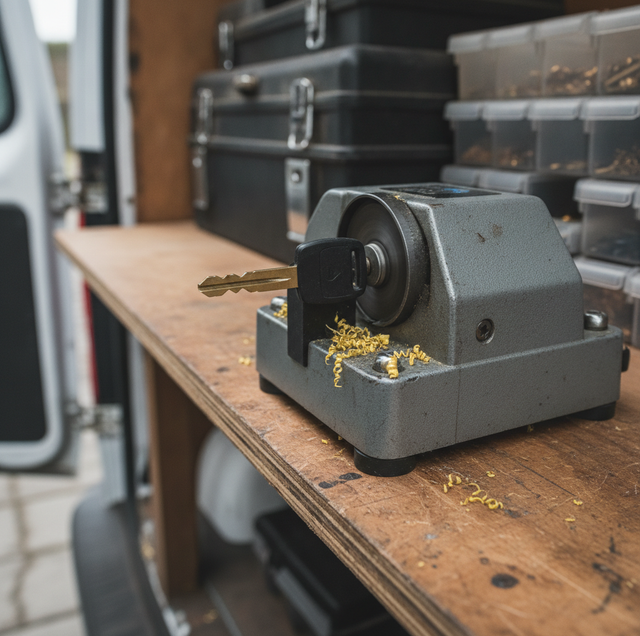
A locksmith has two main routes. The first is cutting by code. Every lock is manufactured with a specific key code, and that code can often be pulled from the VIN using the right database or read directly from a code stamped on the lock cylinder. With the code in hand, the locksmith cuts a fresh blade to exact factory spec on a code machine, and it works the first time.
The second route is reading the lock itself. If the code is not available, a locksmith can decode or impression the existing lock. Decoding uses tools to determine the cuts by measuring the lock's internal pins. Impressioning works a blank inside the keyway, then reads the tiny marks the pins leave on the blank to figure out each depth, filing the cuts in stages until the key turns. It is slower and takes real skill, but it produces a working key with no code and no existing key.
Transponder Keys: Cut the Blade, Then Program the Chip
By the early 2000s, most cars moved to transponder keys. The key looks like a normal metal key, but the plastic head hides a small chip. When you turn the ignition, the car sends out a signal, the chip answers with its code, and only then does the immobilizer allow the engine to start. It is a quiet handshake you never see.
Replacing one from scratch is two jobs in one. First, the blade gets cut, by code or by reading the lock, exactly as with an old mechanical key, so it physically fits the door and turns the ignition. Then the new chip has to be programmed into the car so the immobilizer accepts it. That programming is done through the car's diagnostic port with a locksmith's programming tool, which writes the new key into the vehicle's memory. Skip the programming, and you have a key that turns but never fires the engine.
Remote, Flip, and Push-Button Keys: Originate and Program the Fob
Newer cars raise the difficulty again. A remote or flip key folds a transponder chip together with the lock buttons. A proximity or push-button smart key drops the blade entirely for daily use: you keep the fob in your pocket, the car senses it, and you start the engine with a button. Some of these still hide a small emergency blade inside the door fob, but the day-to-day operation is entirely electronic.
Building one of these with no existing key means originating a new fob and pairing it to the car, and the pairing is where all-keys-lost gets involved. When at least one working key already exists, many cars let a new key be added quickly. With every key lost, the car has no trusted key to authorize the addition, so the locksmith has to follow a more secure procedure to program the first new key into the empty system.
On some vehicles, that procedure includes a built-in security wait, a timed lockout, and the car enforces before it will accept a new key with no existing key present. It is a deliberate anti-theft delay, and it can add a stretch of waiting time to the appointment that no tool can shortcut. On certain models, the process also calls for specific dealer or aftermarket locksmith equipment and access to secure key codes. A well-equipped mobile locksmith handles many of these on-site; a smaller number of the most locked-down models may still route through a dealer.
What You Need to Have Ready
Because a from-scratch key can start any car it is cut and programmed to, the ownership check is not a formality. Have these ready before the appointment:
- Proof of ownership: The title or current registration in your name, matched to a government-issued photo ID. This protects you as much as anyone, since it is what stops a key from being made for a car that is not yours.
- The VIN: The 17-character vehicle identification number is visible through the windshield at the base of the driver's side and printed on the registration. The VIN is what lets a locksmith pull key codes and confirm the exact key your car takes.
- The car itself: The vehicle has to be present, because both cutting to the lock and programming to the immobilizer happen at the car. This is the part that favors a mobile locksmith, who comes to wherever the car is stranded instead of making you move a car you cannot start.
Dealer or Mobile Locksmith?
Both can make an all-keys-lost key, and the right pick depends on your car and your situation. A dealership orders the key tied to your VIN and programs it, which is a solid path, especially for a few high-security models. The trade-offs are that the car usually has to be taken to the dealer, which means a tow if you have no key, and the work happens on the dealer's schedule.
A mobile locksmith comes to the car, which matters when the car is sitting in a parking lot or driveway and cannot be driven or easily towed. A locksmith who stocks the blanks, fobs, and programming tools for your make can often originate and program the key on the spot, in one visit, and generally moves faster and costs less than the dealer route for most everyday vehicles. For most cars on the road, the on-site option is the shorter path back to driving.
Prevention: The Fix That Costs Almost Nothing Later
Everything above is the expensive, slow version of a problem that a spare key erases. The single best move is to have a second key made while you still have a working one, because duplicating a key you already have is quick and simple compared to creating one from scratch. Make the spare before you need it, not during an emergency.
Then store it somewhere it will actually be found. A drawer at home, with a trusted family member, or in a small lockbox, beats leaving it in the glovebox, where it is lost right along with the car if the car is stolen or towed. For a smart key fob, keep the spare in a different bag or hook than the primary, so one misplaced bag does not take both. A few minutes now is the whole insurance policy against the all-keys-lost scenario.
Frequently Asked Questions
There are two ways to get the blade cut, and one reason it can still stall. Cutting by code is the clean route: the factory key code is pulled from the VIN through a licensed locksmith database, or read off a code stamped on the lock cylinder itself, and a code machine cuts the blade to exact spec. When no code is available, the locksmith reads the lock directly by decoding the pin depths or impressioning a blank until it turns. The electronic half is separate: the new chip or fob is written to the immobilizer through the diagnostic port. On several makes, the car enforces a security time-out before it will accept that first new key with none present, an anti-theft delay meant to frustrate a thief working fast, and it applies even to the rightful owner.
The ownership check is handled on a case-by-case basis, which is exactly why the locksmith asks. On a leased or financed car, the title is held by the lienholder or leasing company, so a current registration and matching photo ID usually carry the day, since the registration names you as the registered keeper even when the title does not. If the car is titled to someone else, a spouse, a parent, or a company, the locksmith may want that owner present or a signed authorization, because a key made for a car that is not yours is exactly the abuse the verification exists to stop. Dealer lots, auctions, or newly bought cars where the paperwork has not caught up are the trickiest, and a bill of sale plus ID helps bridge the gap. When in doubt, call ahead and describe the situation so nothing derails the appointment on arrival.
Duplicating a key you already have is often a few minutes. Originating takes longer because the locksmith is cutting a new blade and then programming the electronics to the car from an empty system. On some vehicles, a built-in anti-theft security wait, a timed lockout, the car enforces before it will accept the first new key, adding a fixed stretch of waiting that no tool can skip. Budget meaningfully more time than a simple copy.
A properly stocked van carries the pieces to finish on-site: a code reader or duplicator to cut the blade, blank keys and fobs matched to your make, and a programmer or OBD tool that talks to the immobilizer through the diagnostic port to write the new key in. For the large majority of cars on the road, that is enough to cut, program, and hand you a working key in the driveway or parking lot. A tow becomes unavoidable only in narrow cases: a handful of the most locked-down models whose key codes are released only to dealers, or a car whose ignition lock or immobilizer module is physically damaged and must be replaced rather than simply re-keyed. If you describe the year, make, and model when you book, the locksmith can usually tell you up front which side of that line your car falls on.
No, and the difference is that all-keys-lost costs more effort. Cloning copies the electronic identity of a key you already hold onto a blank, so the car sees a twin of a key it already trusts and no vehicle programming is needed. That is a fast shortcut, but it only works when a working key exists to clone from. With every key gone, there is nothing to clone, so the locksmith has to originate: write a truly new key into the immobilizer through the car itself, which is why an existing-key duplicate can be minutes while a from-scratch key involves the car's own security handshake and, on some makes, a timed lockout before it accepts the first new key.
The rule is simple: the spare only helps if it is stored somewhere separate from the car and easy to find under stress. Do not leave it in the glovebox or a magnetic box under the bumper, since a stolen or towed car takes the spare with it, and a hidden box can be found by the wrong person. A labeled lockbox at home, or a key left with a trusted family member, keeps it retrievable without putting it in the car. It also pays to write down and file the key information, the VIN, and any key code, somewhere safe, so a future cut can be done by code rather than by reading the lock. For a push-button fob, keep the backup in a different bag or hook than your daily key, so one lost bag never claims both.
Get a replacement key made for your car — no tow, no dealer wait, no working key required. KwikPick Lock and Safe serves the Phoenix West Valley. Call (623) 300-1889.
