
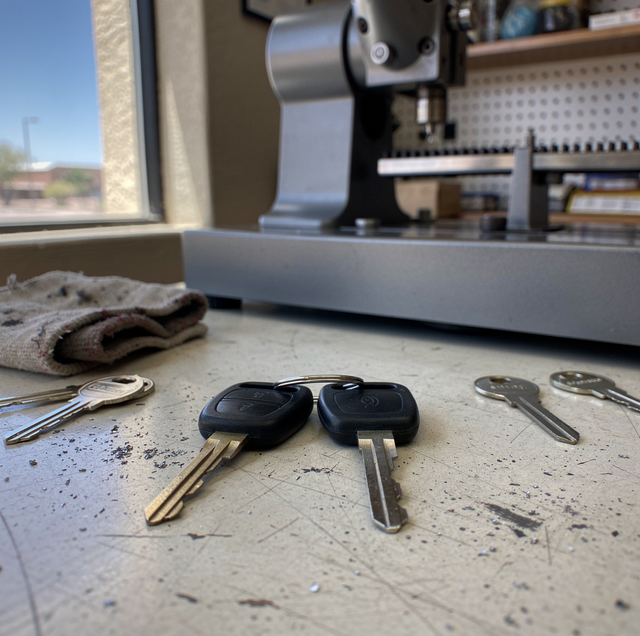
A locksmith can tell whether a car takes a standard edge-cut key or a laser-cut one by looking at the blade, because the two styles are shaped for different machines and read by different locks. The confusion starts before that moment: you know your key needs replacing, but you do not know which category it falls into, and the two are not interchangeable on the shop floor. Knowing the cut style ahead of time lets the shop bring the blank and the machine for that style.
Set the two blades side by side, and the cut, the lock that reads it, and the machine that makes it all differ; the chip row shows the one point where cut style decides nothing.
| Feature | Standard (edge-cut) key | Laser-cut (sidewinder) key |
|---|---|---|
| Where the cut sits | Notches along one or both edges of the blade | A wavy groove milled into the flat face |
| How it fits the lock | Wafers in the lock are lifted into line by the edge cuts | A sidebar and wafers read the face groove |
| What cuts it | A duplicating machine that clamps and traces the edge | A dedicated laser-style machine that mills the face |
| Chip inside? | Depends on the vehicle, not the cut style | Depends on the vehicle, not the cut style |
How to Tell by Looking at the Blade
Hold the key flat and look at the edges first. A standard car key has a row of notches cut into one edge, or into both edges on a two-sided key, each one a different depth, and the pattern of high and low points is what lifts the lock's wafers into line and lets the cylinder turn. Each notch sits at one of several fixed depths on a set scale, and it is the full sequence of depths along the blade, not any single notch, that fits the blade to its lock rather than to a similar-looking cut. Nothing on the flat face of the blade is cut; the face is smooth on both sides.
A laser-cut key looks different at first glance. The top edge is plain, with no notches. Instead, a single wavy groove runs down the center of one or both flat faces, curving side to side rather than up and down. That groove is what the lock reads, not the edge. If you run your eye down the blade and see a continuous curved channel on the face instead of a row of notches on the edge, the car takes a laser-cut key.
A flashlight held at a low angle across the face makes the groove easier to catch, since the curve catches light differently than the flat metal around it. Counting is another check: a standard key shows several distinct notch depths along the edge, each a separate cut, whereas a laser-cut key shows a single continuous path with no separate steps.
Why Laser-Cut Keys Need Different Cutting Equipment
The reason the two keys cannot be cut on the same bench comes down to what each machine does. A standard duplicating machine works by clamping the original key next to a blank and tracing the edge pattern with a cutting wheel, copying the notch depths one at a time along an edge of the blade. A tracing guide rides the original key's edge while the carriage carries both keys past the cutting wheel, so the blank is cut to the same depth at each notch position and the full sequence carries over. That setup only makes sense for a cut sitting on an edge.
A laser-cut key needs a machine built around a different motion: a guided cutting head that follows a wavy path across the flat face of the blank, milling the groove to a set depth as it moves side to side rather than up and down. The machine has to hold the blank steady and move the cutter along a curve rather than along a straight edge, which is a different mechanism from a standard clamp-and-trace duplicator. A shop without that equipment cannot cut a laser-cut blank correctly, no matter how well it copies a standard key. The machine holds each blank in a jaw matched to its profile, since the groove width and the curve it follows have to match the wafers in that particular lock design. A shop that offers laser-cutting keeps a stock of matched blank profiles on hand rather than a single universal blank, because the wrong profile will not seat correctly even if the groove depth is close. The jaw also holds the blank at a fixed height and angle, since the cutting head follows a path measured from that exact starting point, and a blank clamped out of position carries the groove out of position on the face.
Where a spare key exists, bring it along with the daily key. A shallow groove or notch shows as a softer outline beside the spare's crisp one, and the sharper of the two gives the machine the better pattern to trace.
The Chip Is a Separate Question
A cut style tells you nothing about whether the key also carries a transponder chip, because the two are decided independently by the vehicle. A car can pair a standard edge-cut blade with a chip in the plastic head, an older car can take an edge-cut key with no chip at all, and a laser-cut blade can carry a chip or sit in a head without one. Whether your particular key needs a chip programmed alongside the correct cut is its own issue, tied to what stops the engine from starting when the car does not recognize the key.
Copying vs Originating a Key
If a working key exists, a locksmith can trace it on the machine that matches its cut style, standard or laser, and cut a copy from it. When no working key is left, the cut has to come from the vehicle's key code or its locks rather than from a key in hand, a longer process with its own proof-of-ownership step. One detail carries over either way: whichever cut style the car takes has to be settled first, because choosing the wrong one means starting over with a blank of the correct style, and any chip programming that follows has to wait until that correct blank is in hand.
What to Bring
Bring the key you already have whenever one exists, even if it is broken, worn, or only turns part way; the blade tells the shop everything it needs about the cut style without any guessing over the phone.
Frequently Asked Questions
Yes, in the width of the keyway. A laser-cut key is milled from thicker blade stock than a standard edge-cut key, so the slot it passes through in the lock is a little wider to match. That width difference is easy to miss by eye, and it is only a hint; the key itself, or the car's key-code record, determines which style the lock takes.
A laser-cut blank can be milled the same on both faces, so the key inserts into the lock right-side up or upside down and still works. A standard edge-cut car key, cut on one edge, is right-side-up, while one cut on both edges turns the lock either way. That difference in the blank itself is separate from anything about the groove pattern or the notches.
On some vehicles, yes. A laser-cut blank is a thicker blade, and on some vehicles, a harder alloy, because the milled groove requires enough material in the face to maintain its depth without weakening the blade. A standard edge-cut blank can be a thinner brass or nickel-silver stock, since the cut sits on the edge rather than removing material from the face.
It can. A manufacturer can change the ignition and lock system partway through a model's production run, so two cars with the same name on the trunk can take different key styles depending on when each one was built. The model name alone does not guarantee which cut a specific car needs; the blade, the lock, or the car's key-code record has to confirm it.
Yes. A snapped-off piece can keep enough of the groove or the notch pattern near the shoulder of the blade to show which style it is, since that section sits closest to where the cutting starts. A locksmith can use that fragment alone to confirm the cut style before the correct blank is pulled.
No. The buttons and the folding shell on a remote head or flip key are built around the same blade styles used in a plain key, so a remote head can hide either a standard edge-cut blade or a laser-cut one inside its shell. The shell and buttons are about how you carry the key, not what kind of cut turns the lock.
Choose car key cutting matched to your key's style — standard edge-cut and laser-cut blades are each cut on the machine built for that cut, and chip keys are programmed to the car. KwikPick Lock and Safe serves the Phoenix West Valley. Call (623) 300-1889.