
Car Won't Start but Lights Work: Ignition or Key?
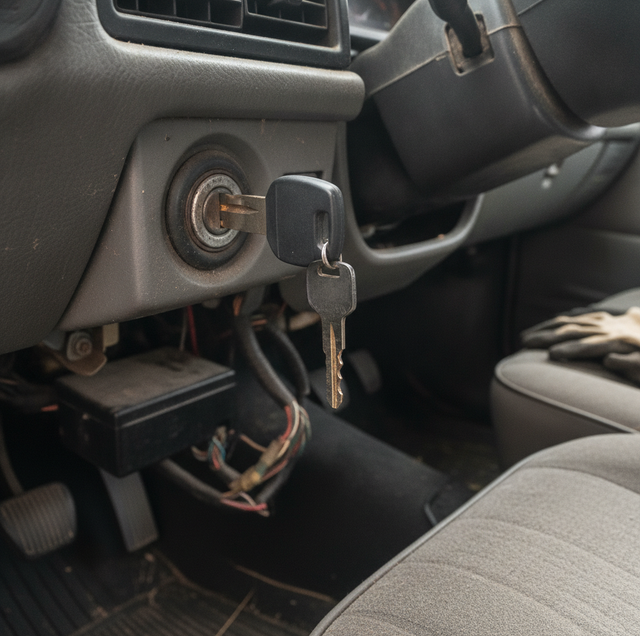
You turn the key or press the button, the dash lights up like normal, the radio might even come on, and then nothing. No engine. It is one of the more confusing no-start situations because everything visible seems fine, yet the car sits there.
Quick Answer: Working lights tell you the battery still has some charge, so the fault usually sits between the key or immobilizer, the ignition switch, the starter, or a battery too weak to crank. The fastest clue is whether the engine cranks (turns over) or stays silent, plus what the dash security light does when you try to start.
The reason lights alone do not clear the battery is worth understanding before you start guessing at parts, so let us walk through the mechanism first.
Why Working Lights Do Not Mean a Good Battery
Think of your car's electrical system like a household water line. Running a single faucet takes barely any pressure, and it flows fine even when the supply is low. Try running the shower, the dishwasher, and the sprinklers at once, and suddenly there isn't enough pressure to go around. The dash lights and radio are that single faucet. The starter motor is every fixture opening at once.
The starter has to spin a cold engine against compression, which requires a heavy, sustained burst of current for a second or two. A battery that has drained down, or one with aging internal cells, can still push the tiny amount of power the lights need, but collapse the moment the starter asks for its share. So a lit dashboard confirms the battery is not fully dead. It does not confirm that the battery is strong enough to start the car. That gap is where most of the confusion in this scenario lives.
Here are the usual suspects, roughly in the order a technician would think through them.
The Common Causes, From Simple to Involved
A Weak Battery That Lights but Won't Crank
This is the most frequent cause and the easiest to overlook precisely because the lights work. The tell is the sound when you try to start: a single click, a rapid clicking, or dead silence where the crank should be. If the lights visibly dim or the dash flickers at the moment you try to start, that is the battery sagging under load, a strong sign that it cannot supply starter current. Interior electronics running fine is not evidence to the contrary.
The Key, Transponder, or Fob Not Being Recognized
Nearly every vehicle built in the last couple of decades has an immobilizer, a security system that will not let the engine run unless it reads the correct chip in your key or fob. When the immobilizer does not see a valid key, the car protects itself by refusing to start. The signature is a security light or a key-shaped warning light on the dash, often blinking, and on a traditional key car, the engine may crank freely but never fire. On a push-to-start car, it may refuse to crank at all.
Causes here include a transponder chip that has worn or failed, a fob with a dead coin-cell battery, or a key that the car has stopped reading after electrical work or a module hiccup. Extreme heat is hard on these small electronics, and a fob that lived in a hot center console for years can simply give out.
A Worn Ignition Switch or Cylinder
The ignition switch is what actually closes the start circuit when you turn the key. Over years of use, the cylinder wears, the internal contacts pit, or the key itself rounds off at the cut points. Two patterns point here: the key turns normally, but nothing happens electrically, meaning the switch is not completing the circuit, or the key will not turn at all because a worn key and a worn cylinder no longer match. Push-to-start cars have an ignition module rather than a cylinder, but the same idea applies. The circuit that authorizes the start is not closing.
The Starter, Relay, or Solenoid
If the battery is healthy and the security system is satisfied, attention moves to the starter itself. A failed starter motor, or a bad starter relay or solenoid, typically gives you a single sharp click and no crank when you try to start. Sometimes tapping or repeated attempts get one more start out of a dying starter, which is a clue rather than a fix.
A Safety Interlock That Is Not Satisfied
Before blaming any expensive part, rule out the interlocks. An automatic will not crank unless it is in Park or Neutral, and many cars need a firm brake pedal press to start. A manual usually requires the clutch to be pushed fully to the floor. A shifter slightly out of the Park detent, a neutral-safety switch acting up, or a brake or clutch switch not registering can all produce a no-start with a perfectly lit dash.
How to Narrow It Down Yourself
You do not need tools to sort this into the right category. You need to listen and watch.
First question: Does it crank? Cranking is the rhythmic churning sound of the engine turning over. If it cranks but never catches and runs, the starting motor and battery are doing their job, so the problem is on the fuel, spark, or immobilizer side. If it does not crank at all, you are looking at the battery, the starter, the ignition switch, or an interlock.
Second: What does the security light do? If a security or key icon flashes when you try to start, or the engine cranks but will not fire, suspect the key or immobilizer. A steady behavior with no security warning points away from the key.
Third: What is the sound? A single click leans toward the starter or a battery too weak to engage it. Rapid clicking leans toward a low battery. Total silence with a lit dash can be an interlock, a switch, or a relay.
Fourth: Check the easy interlocks. Shift firmly into Park, or try Neutral. Press the brake harder, or the clutch to the floor. Wiggle the shifter. If the car starts, an interlock switch was the culprit.
Running through those four in order will usually tell you which specialist you need, without touching a single component.
Who Fixes What: Locksmith or Mechanic
The split is cleaner than most people expect. If the trouble is the key, the fob, the transponder, or the ignition cylinder, that is locksmith territory. An automotive locksmith cuts and programs keys and fobs, diagnoses and repairs worn transponder keys, and services ignition lock cylinders. If the trouble is a dead battery, a failed starter, or a charging problem, that is a mechanic's job.
The crank-versus-no-crank test and the security-light clue are what point you to the right door. A car that cranks but will not fire, with a flashing security light, is very often a key or immobilizer issue rather than a mechanical one. Sorting that out before you tow the car anywhere can save an unnecessary trip.
A note on safety and scope: automotive starting systems carry real current, and modern immobilizers are security devices for a reason. This guide is about diagnosis, not defeating anything. If you have narrowed the problem to the key, the immobilizer, or the ignition, the right move is a qualified automotive locksmith who can read the fault and correct it properly.
Frequently Asked Questions
Lights and interior electronics draw very little power, while the starter motor needs a large, sudden burst to turn the engine over. A battery weakened by age or a slow drain can still light the dash brightly while collapsing under the starter's much heavier demand. That is why a load test, which measures how the battery holds voltage while supplying a heavy draw, tells you far more about its true condition than simply seeing the lights come on does.
Watch the dash and listen. A security light or key-warning light that flashes when you try to start, or an engine that cranks over but never fires, points to the immobilizer failing to recognize the key. By contrast, a key that will not physically turn, or one that turns with no electrical response at all and no security warning, points to the ignition cylinder or switch rather than the security system.
Often it can, but most push-to-start vehicles have a backup path built in for exactly this. Many let you hold the fob directly against a marked spot on the start button or the steering column, where a small antenna reads the chip at close range, even with the coin-cell battery dead. Check the owner's manual for the exact spot on your model. So a dead fob battery is not always a true no-start, though it is worth replacing that coin cell promptly.
Cranking is the churning sound of the engine turning over; no-crank means the engine does not rotate. Beyond that, yes-or-no, listen to the crank itself, because its quality is a clue. A slow, labored crank that sounds like it is dragging points to a marginal battery or a corroded connection. A single loud click with no crank points to the starter solenoid. And a whir with no engine turning points to a failed starter drive gear that is spinning but not catching the flywheel. Each of those three sounds narrows the fault before anyone opens the hood.
Yes, and this catches people off guard. A key does two separate jobs: the mechanical cuts that work the door lock, and the transponder chip that tells the car to start. Either the chip can degrade, or the cut can wear down enough that the car no longer reads it for starting, while the door still works because that side has more tolerance. A door that opens is no guarantee that the start function is intact, and that mismatch is a key or programming issue a locksmith resolves.
The split follows what you found. Crank-but-no-fire with a security light, a key that will not turn, or a dead or mismatched fob leans locksmith; no-crank with a click and a battery that struggles under load leans mechanic. One practical detail worth knowing before you book: a mobile locksmith can usually cut and program keys and fobs on-site for most makes, but a few high-security or newer immobilizer systems still need dealer-only programming. Ask about your specific make and model up front, so you know whether a mobile visit can finish the job or if the car will need to go to the dealer for that one step.
Call for mobile automotive key and ignition diagnosis — get an on-site read on whether it's the key, fob, or ignition before you tow anywhere. KwikPick Lock and Safe serves the Phoenix West Valley. Call (623) 300-1889.
